If the salt level in your water softener hasn’t moved in weeks, the softener has probably stopped softening, even though it may still sound like it’s running. A softener uses salt every time it regenerates. If the salt never goes down, the unit isn’t regenerating, or it’s trying to and can’t pull brine.
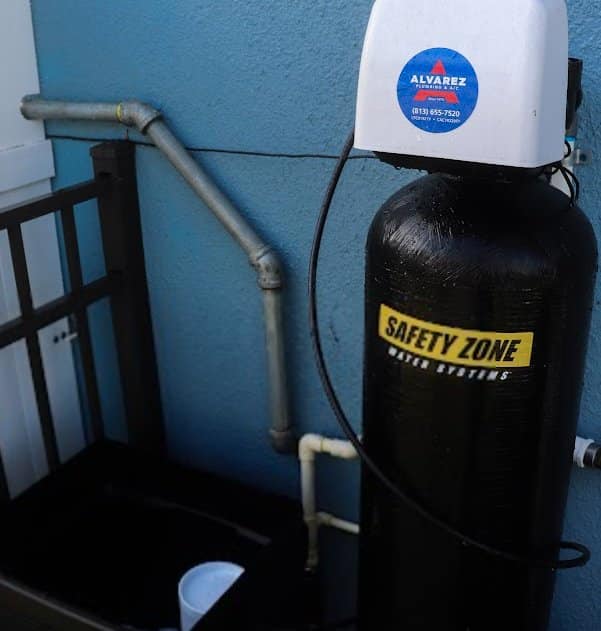
This one is personal: it happened in my own home. The salt wasn’t going down, but the water had no chlorine taste or smell, so the system seemed fine. It wasn’t. The chlorine was being filtered out, but the water wasn’t soft.
Here’s what to look for, what usually fixes it, and when it’s time to call a pro.
Why the salt isn’t going down
These are the most common causes, starting with the easiest to check.
- Salt bridge. A hard crust forms across the brine tank, and the salt above it never touches water. The tank looks full, but there’s an empty space underneath. Florida humidity makes bridges more likely.
- Salt mushing. Dissolved salt recrystallizes into a thick sludge at the bottom of the tank. The softener can’t pull brine through it. Cheaper salt that’s high in insoluble material makes it worse.
- The bypass valve is on. If someone bypassed the softener for a repair or for watering the lawn and never switched it back, water skips the softener entirely.
- The clock or settings are wrong. Many timer-based units lose the time after a power outage. The unit may be regenerating at the wrong time, or not at all.
- Clogged injector or brine line. The injector (venturi) is a small part that creates the suction that pulls brine from the tank. Sediment or salt debris can block it, and then no brine moves.
- Stuck float or brine valve. This valve controls how much water refills the brine tank. If it sticks, the tank may not refill, or it may overfill.
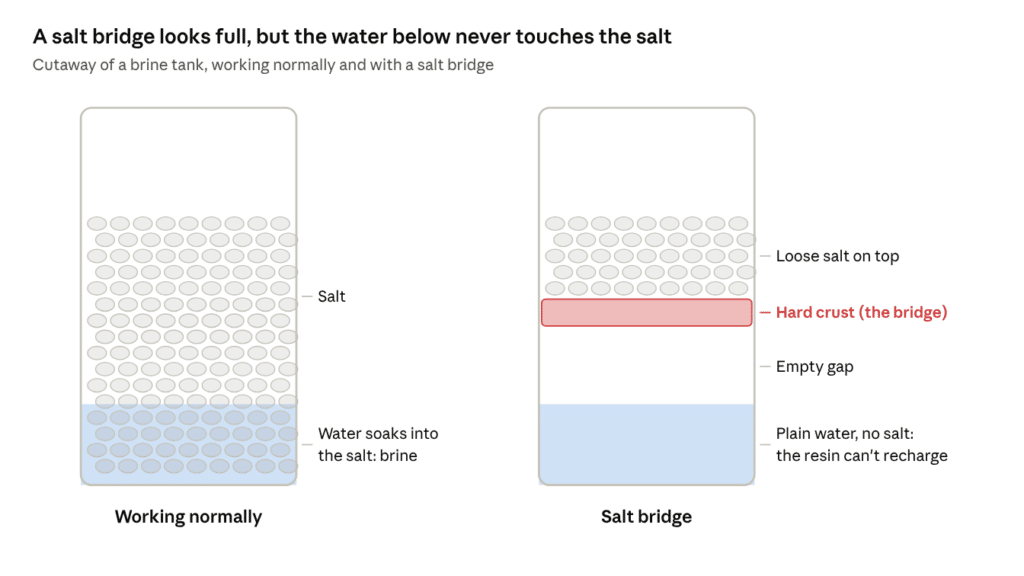
From the top, both tanks look full of salt. With a bridge, the water at the bottom never reaches it, so the salt level stays the same week after week.
When it seems to work but you still have hard water
A softener can click, cycle and even use some salt while hard water still reaches your taps. Watch for spots on dishes, crusty showerheads, dry skin and soap that won’t lather. Common reasons:
- Hardness setting too low. The unit thinks your water is softer than it is, so it regenerates too rarely and runs out of capacity between cycles.
- Worn-out or fouled resin. The resin beads do the softening. Over the years, or with iron in the water, they lose their ability to grab hardness minerals.
- Undersized unit. A larger household or a new bathroom can use more water than the softener can treat between regenerations.
- Hard water leaking past the resin. A partly open bypass, worn seals in the control valve or a cracked distributor tube lets untreated water slip through.
- Brine too weak. If the brine tank doesn’t refill properly, regeneration uses too little salt, and the resin only partly recharges.
Chlorine is gone, but the water is still hard. Many systems pair the softener with a carbon filter. The carbon removes chlorine on its own, without salt or regeneration. So the water can taste and smell clean even after the softening side has stopped working. Clean-tasting water doesn’t mean soft water.
A cheap water hardness test strip settles it. Test the water at a faucet after the softener. If it’s still hard, the softener isn’t doing its job, whatever the salt level says.
Does the type of salt matter?
Yes. The wrong salt is one of the most common causes of bridges and mushing. For most homes, evaporated salt pellets are the safest choice.
| Salt type | What it is | Good for | Watch out for |
|---|---|---|---|
| Evaporated pellets | The purest salt, pressed into pellets | Most softeners; the lowest risk of mushing | Costs a little more per bag |
| Solar salt crystals | Salt left behind when seawater evaporates | Many units, especially in moderate-hardness areas | More impurities than pellets; can bridge in humid garages |
| Rock salt | Mined salt, less refined | Rarely recommended | Insoluble material builds up as sludge |
| Potassium chloride | A sodium-free alternative | People limiting sodium | Costs more; the unit may need a higher setting to soften as well |
Check your softener’s manual before switching types. Don’t mix types in the tank, and don’t let the salt sit more than about half full in a humid space.
How water flows through a softener
Knowing the path the water takes makes it easy to see where things break. Most of the time, water runs through the resin and comes out soft. Every few days, the softener regenerates to recharge the resin, and that’s the only time it uses salt.
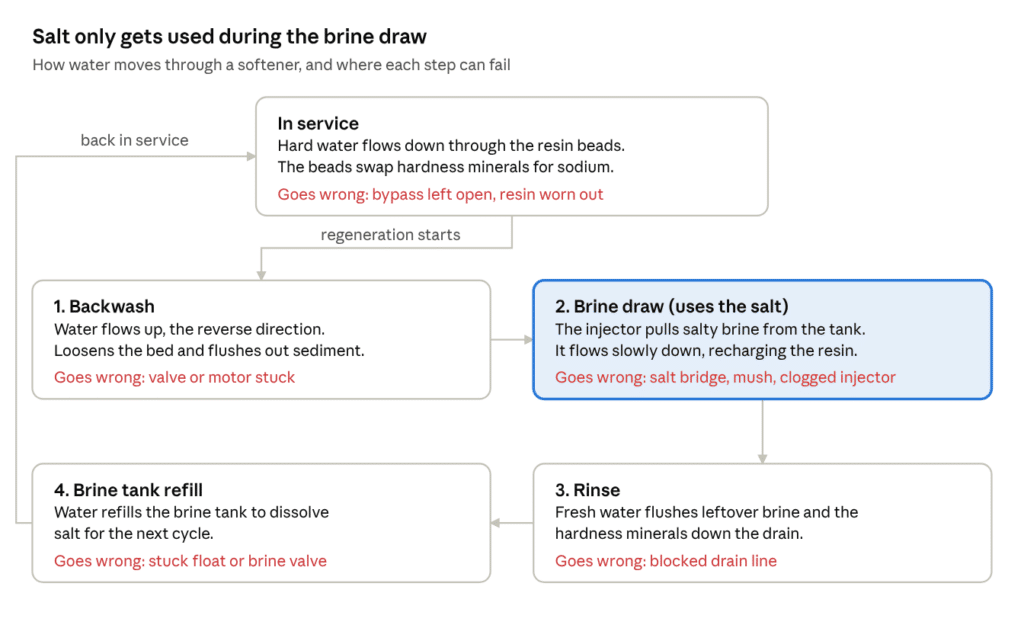
If any step stalls, especially the brine draw, the salt level stays put and hard water gets through.
What to check yourself
Work through these in order. Most salt problems are solved by step 3.
- Test your water. Use a hardness test strip at a cold-water faucet. Hard water confirms there’s a problem.
- Check the bypass valve. Make sure it’s set to “service,” not “bypass.”
- Look for a salt bridge. Gently push a broom handle down into the salt. If it hits a hard layer with space underneath, break it up carefully, without hitting the tank walls.
- Look for mushing. If there’s a thick sludge at the bottom, scoop it out, then refill with fresh pellets.
- Check the clock and settings. Reset the time of day, and confirm the hardness setting matches your water test.
- Run a manual regeneration. Most units have a “regen” button. Afterward, the water level in the brine tank should drop.
- Retest in a day or two. If the water is still hard, the problem is likely inside the valve, injector or resin.
When to call a professional
Call a plumber or water treatment specialist if any of these apply:
- The salt still isn’t going down after you break up a bridge and run a manual regeneration.
- There’s standing water high in the brine tank, or the tank overflows.
- Your water tests hard even though salt is being used.
- You see small tan or amber beads in faucet aerators or toilet tanks. That points to a broken part inside the resin tank.
- The unit shows an error code, leaks, or makes grinding or constant running sounds.
- The softener is more than 10 to 15 years old, or your household’s water use has grown a lot.
At Alvarez, we diagnose and repair water softeners across the Tampa area, and we can tell you whether a repair or a replacement makes more sense. Schedule a water softener service and we’ll get your water soft again.