Tankless Water Heater Installation in Tampa, From a Name You Know
A tankless water heater heats water only when you turn on a tap. There’s no 40- or 50-gallon tank to keep hot around the clock, so you get endless hot water on demand without paying to reheat water you aren’t using.
Since 1976, Alvarez Plumbing & Air Conditioning has been the family-owned, veteran-owned plumber Tampa Bay families call first. Rated 4.8★ from more than 2,700 Google reviews, our licensed plumbers install, upgrade and repair tankless water heaters from South Tampa to Wesley Chapel. We’ll help you choose between gas and electric, size the unit to how your family actually uses hot water, and handle any gas line, venting or electrical work your install needs.
Call Alvarez at (813) 655-7520 for a tankless water heater evaluation in Tampa.
Gas vs. Electric
Gas Tankless Water Heaters: The Preferred Choice for Tampa Homes
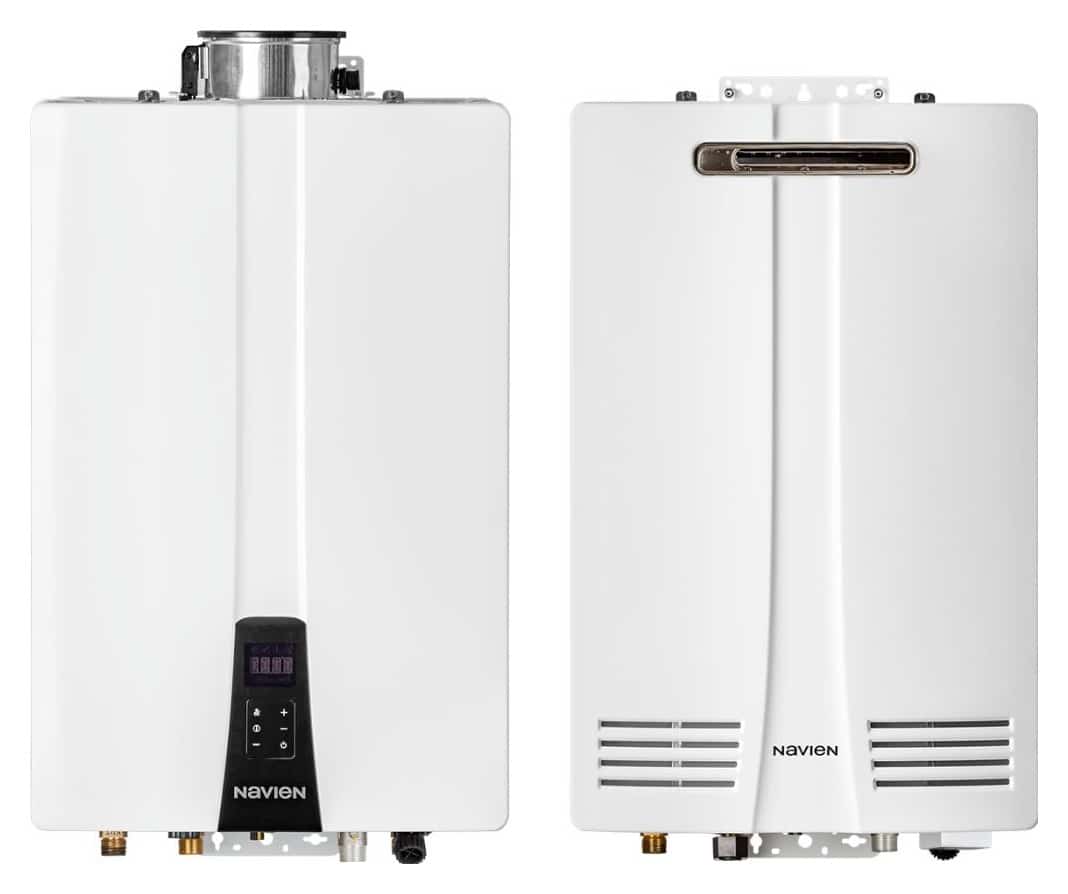
At Alvarez, we recommend a gas tankless water heater for most Tampa homes. A gas burner can heat far more water per minute than electric elements, so you can run two showers and the dishwasher at the same time without anyone getting a cold surprise.
Why Alvarez recommends gas first
- More hot water at once. Whole-home gas units are rated up to 199,000 BTU, enough to keep several fixtures running together.
- Little electrical work. A gas unit only needs a standard outlet for its controls, so your electrical panel usually stays as it is.
- Works on natural gas or propane. If your home already has gas, most of the infrastructure is in place.
- Indoor or outdoor installs. Many Florida homes mount the unit on an outside wall, freeing up the closet or garage space the old tank used.
- A properly sized gas line. Tankless units draw more gas at once than a tank, so the line from the meter is often upsized.
- Correct venting. Condensing models vent through PVC; non-condensing models need stainless venting.
- A condensate drain for high-efficiency condensing models.
- A check of your gas meter's capacity with your other gas appliances.
Alvarez's licensed plumbers check all of this during your in-home evaluation, so your written quote includes everything up front, with no surprises on install day.
No gas at your home?
Electric Tankless Water Heaters: They Can Work, With the Right Upgrades
If your home is all-electric, tankless is still an option. Whole-home electric units draw a lot of power at once, so the key question is whether your electrical service can support one.
- Panel or service upgrade. A whole-home electric tankless unit typically needs about 100 to 150 amps at 240 volts. That can use most of a 200-amp panel, so many homes need a service upgrade first.
- Several dedicated circuits. Larger units run on multiple heavy-gauge 240-volt circuits, each with its own breaker.
- New wiring to the unit. Heavy-gauge wire is run from the panel to the water heater location.
The Tampa advantage
Our groundwater stays warm most of the year, so an electric unit doesn't have to raise the temperature as much as it would up north. That helps electric tankless perform better here than in colder climates.
Point-of-use option
For a single bathroom, an addition or a far-away kitchen sink, a small point-of-use electric unit can be a simple fix that usually needs only one dedicated circuit.
The Alvarez approach: we look at your panel before recommending anything, and we'll tell you plainly if a heat pump or tank water heater makes more sense for your home.
Gas vs. electric tankless water heaters at a glance
| Gas tankless | Electric tankless | |
|---|---|---|
| Hot water output | Higher. Handles several fixtures at once. | Lower. Best for smaller households or fewer fixtures at a time. |
| Electrical needs | A standard outlet for the controls | About 100 to 150 amps at 240 V for whole-home units, on several dedicated circuits |
| Common upgrades | Gas line sizing, venting, condensate drain | Panel or service upgrade, new circuits and wiring |
| Venting | Required | None |
| Best for | Most Tampa homes with gas service | All-electric homes with enough electrical capacity, or point-of-use needs |
Benefits
Benefits of a Tankless Water Heater
Endless hot water
Water is heated as it flows, so a properly sized unit doesn't run out halfway through the third shower.
Lower energy use
There's no tank kept hot around the clock, so you stop paying to reheat water you aren't using.
Longer life
Tankless units can last 20 years or more. Tank water heaters typically last 10 to 15.
Saves space
A wall-mounted unit about the size of a suitcase replaces a bulky tank. Outdoor installs free up the space entirely.
No tank to burst
Without 40 or 50 gallons stored in a tank, a sudden tank failure can't flood your garage or closet.
Steady temperature and smart control
Modern units hold a set temperature and can be adjusted from an app. Recirculation options bring hot water to the tap faster.
The real numbers
How Much Does a Tankless Water Heater Actually Save?
Short answer: an ENERGY STAR gas tankless water heater saves a typical family of four about $95 a year compared with a gas tank, or about $1,800 over its life. Beyond that, the honest answer is that how much you save depends on how much hot water your household uses, your fuel type and what you're replacing. Here's what the government's own data shows.
Where the savings come from
- No standby loss. A tank keeps 40 or 50 gallons hot all day and night. Tankless only heats water when a tap is open.
- A longer life. One tankless unit can outlast two tank water heaters, which means one less replacement and one less install bill.
- Smaller households save the most. The less hot water you use, the bigger the efficiency gain over a tank.
The trade-off: tankless costs more up front than a tank, especially if your home needs a larger gas line or an electrical upgrade. Payback time varies by home. Alvarez will walk you through your real costs and expected savings before you decide, and financing is available.
Sources: U.S. Department of Energy, Energy Saver: Tankless or Demand-Type Water Heaters. ENERGY STAR: Gas Tankless Water Heaters, Benefits & Savings.
The brand we install
Rinnai Tankless Water Heaters, Installed by Alvarez
Alvarez installs Rinnai tankless water heaters, one of the most trusted names in tankless. We chose Rinnai for its reliability, efficiency and strong warranty support, and our plumbers know these units inside and out.
Schedule Service- High-efficiency condensing models. Rinnai's SENSEI condensing line is rated up to 0.98 UEF.
- Natural gas or propane. Models can be installed indoors or outdoors.
- Smart recirculation available. Select models learn your household's routine and have hot water ready at the tap when you need it.
- App control. Setup and settings through the Rinnai Central app, with an optional Wi-Fi module for remote control.
- Strong warranty. SENSEI residential models carry a 15-year heat exchanger warranty, plus 5 years on parts and 5 years on labor when the unit is registered within 90 days of installation.
Warranty terms per Rinnai's SENSEI residential limited warranty. Coverage requires proper installation and maintenance.
Tampa hard water
Tankless Water Heater Repair & Maintenance in Tampa
Tampa Bay's water comes from the Floridan Aquifer and is high in minerals. Over time that scale builds up inside a tankless unit's heat exchanger, cutting efficiency and output. Annual descaling keeps your unit running like new and protects your warranty.
Already have a tankless unit? Alvarez repairs all major brands, gas and electric, with 24/7 service when you're out of hot water. Comparing options? See our tank water heaters and hybrid heat pump water heaters.
Our tankless services
- New tankless installation and tank-to-tankless conversions
- Gas line, venting and electrical upgrade coordination
- Annual flushing and descaling
- Error codes, ignition problems and low hot water output
- Water softener installation to cut down on scale
Call (813) 655-7520 to schedule.
Current offers
Save With Alvarez Coupons
Mention the coupon when you call (813) 655-7520 or enter the code when you request service. Coupons can’t be applied to estimates or the dispatch fee. Some restrictions may apply.
Why Alvarez
Why Tampa Homeowners Choose Alvarez for Tankless Water Heaters
Looking for the best tankless water heater installer in Tampa? When you want the job done right the first time, you want a plumber with a track record. Alvarez has been earning Tampa's trust for 50 years.
What you get with Alvarez
- An honest recommendation: gas, electric, or staying with a tank if that's the better fit
- Correct sizing based on your home's hot water demand
- Licensed plumbers who handle the gas, venting and electrical details
- Clear written pricing before work starts, with financing available
- Veteran-owned, with a team of 120+ local employees
Tankless service areas
Tampa, South Tampa, Brandon, Riverview, Carrollwood, Temple Terrace, Town 'n' Country, Lutz, Land O' Lakes, Wesley Chapel, Valrico, Seffner, Plant City, Ruskin, Clearwater, St. Petersburg and Bradenton.
Schedule Service (813) 655-7520Tankless Water Heater FAQs
What tankless water heater problems does Alvarez Plumbing repair?
We repair all major brands of tankless water heaters — gas and electric — including issues with ignition failure, error codes, cold water sandwiching (a burst of cold water mid-use), insufficient hot water output, and scale buildup from Tampa’s hard water that restricts flow through the heat exchanger. We also handle annual maintenance and descaling to keep your unit running efficiently. Call (813) 655-7520 for a written estimate.
Why is my tankless water heater not producing enough hot water?
Insufficient hot water from a tankless unit is usually one of three things: 1) the unit is undersized for your household’s simultaneous demand (common if the unit was installed without a proper load calculation), 2) the flow sensor or heat exchanger is scaled from Tampa’s hard water, or 3) the unit needs a service and descaling. If your unit was sized correctly when installed and the problem developed gradually over time, scale buildup from the Floridan Aquifer’s mineral content is the most likely cause. A water softener installation significantly reduces scale buildup and extends tankless unit life.
How often should a tankless water heater be serviced in Tampa?
Annual servicing is the standard recommendation for most households. In Tampa Bay specifically, the Floridan Aquifer’s hard water means mineral scale builds up faster inside the heat exchanger than it would in softer water regions — so annual descaling is particularly important here. Skipping maintenance accelerates wear, reduces efficiency, and can eventually cause the unit to fail. We recommend pairing a tankless water heater with a water softener to reduce the frequency of descaling needed.
Is a tankless water heater worth it compared to a traditional tank?
For many Tampa Bay households, yes — tankless units provide hot water on demand without the standby energy loss of keeping a full tank heated continuously. They also last longer than tank units (typically 20 years or more vs. 10–15 years, according to the U.S. Department of Energy) and take up significantly less space. The upfront cost is higher, and in Tampa’s hard water environment they require more consistent maintenance. We can walk you through the comparison for your specific household size and usage pattern. See our full water heater installation and services page.
Does Alvarez Plumbing service all tankless water heater brands?
Yes — we service and repair all major gas and electric tankless water heater brands. We also handle full unit replacements and new installations. If your unit is displaying an error code or has stopped working, call (813) 655-7520 and we’ll diagnose it and give you a written estimate before any work begins.
Is a gas or electric tankless water heater better for a Tampa home?
For most Tampa homes, gas is the better choice. A gas tankless water heater delivers more hot water per minute, so it can run several showers and appliances at once, and it needs only a standard outlet for its controls. Electric tankless can work in all-electric homes, but whole-home units often need an electrical panel or service upgrade. Alvarez will check your gas line and electrical panel and recommend the right fit.
How much does a tankless water heater save per year?
According to ENERGY STAR, a certified gas tankless water heater saves a family of four about $95 a year compared with a gas storage tank, or about $1,800 over its lifetime. The U.S. Department of Energy reports tankless units are 24–34% more efficient than tanks for homes using 41 gallons of hot water a day or less. Your actual savings depend on your household’s hot water use and fuel type.
Do I need to upgrade my electrical panel for an electric tankless water heater?
Often, yes. A whole-home electric tankless water heater typically draws about 100 to 150 amps at 240 volts across several dedicated circuits, which can use most of a 200-amp panel. Many homes need a service upgrade and new wiring first. Smaller point-of-use electric units usually need just one dedicated circuit. Alvarez evaluates your panel before recommending an electric unit.
What size tankless water heater do I need?
Tankless water heaters are sized by flow rate (gallons per minute) and temperature rise, not by tank gallons. The right size depends on how many fixtures your family runs at the same time. Tampa’s warm groundwater means a unit has less work to do than in colder climates. Alvarez sizes every unit with a load calculation so you don’t end up with lukewarm showers.
What brand of tankless water heater does Alvarez install?
Alvarez installs Rinnai tankless water heaters, including high-efficiency condensing models rated up to 0.98 UEF that run on natural gas or propane. Rinnai’s SENSEI residential models include a 15-year heat exchanger warranty, plus 5 years on parts and labor when registered within 90 days. We also repair all major tankless brands.
How long does a tankless water heater last?
A tankless water heater can last 20 years or more, compared with 10 to 15 years for a typical tank water heater, according to the U.S. Department of Energy. In Tampa, annual descaling is key to reaching that lifespan, because the area’s hard water leaves mineral scale inside the heat exchanger.